















A popular slang term among Gen Z and Alpha, "mogging" is currently used in a playful way – even if it has a darker backstory.
The Collins English Dictionary has announced a Word of the Year since 2013, a term selected by a team of lexicographers who look at "how often words are used" and who "analyse patterns of usage" that reveal the latest linguistic trends.
 ADVERTISEMENT
Following the likes of "permacrisis", "AI", "Brat" and last year's "vibe coding", we now have this year's pick: "Mogging".
The slang word is a popular term among Generation Z and Alpha, and means outperforming, outshining, or upstaging someone or something.
It went mainstream this year, with a 210 per cent increase in its usage.
Alex Beecroft, the managing director of Collins, said: “The selection of ‘mogging’ as Collins’ word of the year shows how each generation leaves its mark on language."
“It’s a great example of how Gen Z and Gen Alpha have adopted a word and turned it into humorous slang, making the language their own and ‘mogging’ the rest of us.”
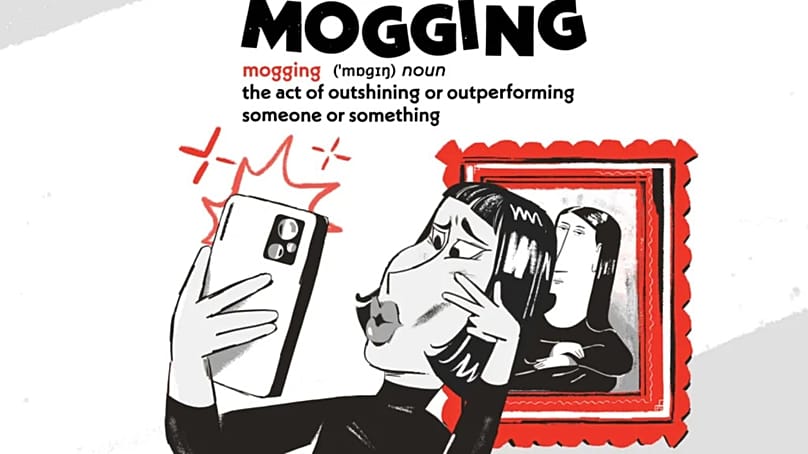
Like Dictionary.com's 2026 Word of the Year "Maxxing", it has a darker side.
While "looksmaxxing" refers to efforts to optimise appearance, "mogging" implies more of a comparison, as it often refers to outclassing someone.
Where its sinister undertones surface is in its origins. "Mogging" can be traced back to the acronym AMOG, which stands for Alpha Male of the Group. In the past, it has been associated with bodybuilding forums as well as the manosphere - the toxic network of online websites, forums and social media accounts that promote aggressive masculinity and anti-feminism.
Nowadays, the new generations have moved the word on from its toxic subculture roots and usually employ it in a playful or teasing way.
For instance, if your friend says to you that you’re "mogging everyone in this room", you know you're doing something right at the party.
"Mogging" is listed by Collins as a noun but, like "maxxing", can be used as a suffix, with declinations including "stylemogging", "carmogging" and "lifemogging" - the latter meaning creating and leading a more impressive life compared to others.
It seems that no matter how ironically or playful the usage is, a sense of hierarchy still prevails...
"Mogging" saw off competition from other words such as “Manchesterism” (a term associated with UK Prime Minister Andy Burnham), “carspreading” (which refers to automobile manufacturers increasing the length and width of vehicles), and “hydration break” - the latter having been made famous by this year's controversial World Cup.
Other runners up this year include "Ghost jobs", referring to vacancies that are advertised by employers who have no intention to fill them; “Bixie", a hairstyle that is shorter than a bob but longer than a pixie cut; and "P(doom)", an estimation of the probability that AI will bring about the collapse of human civilization.