

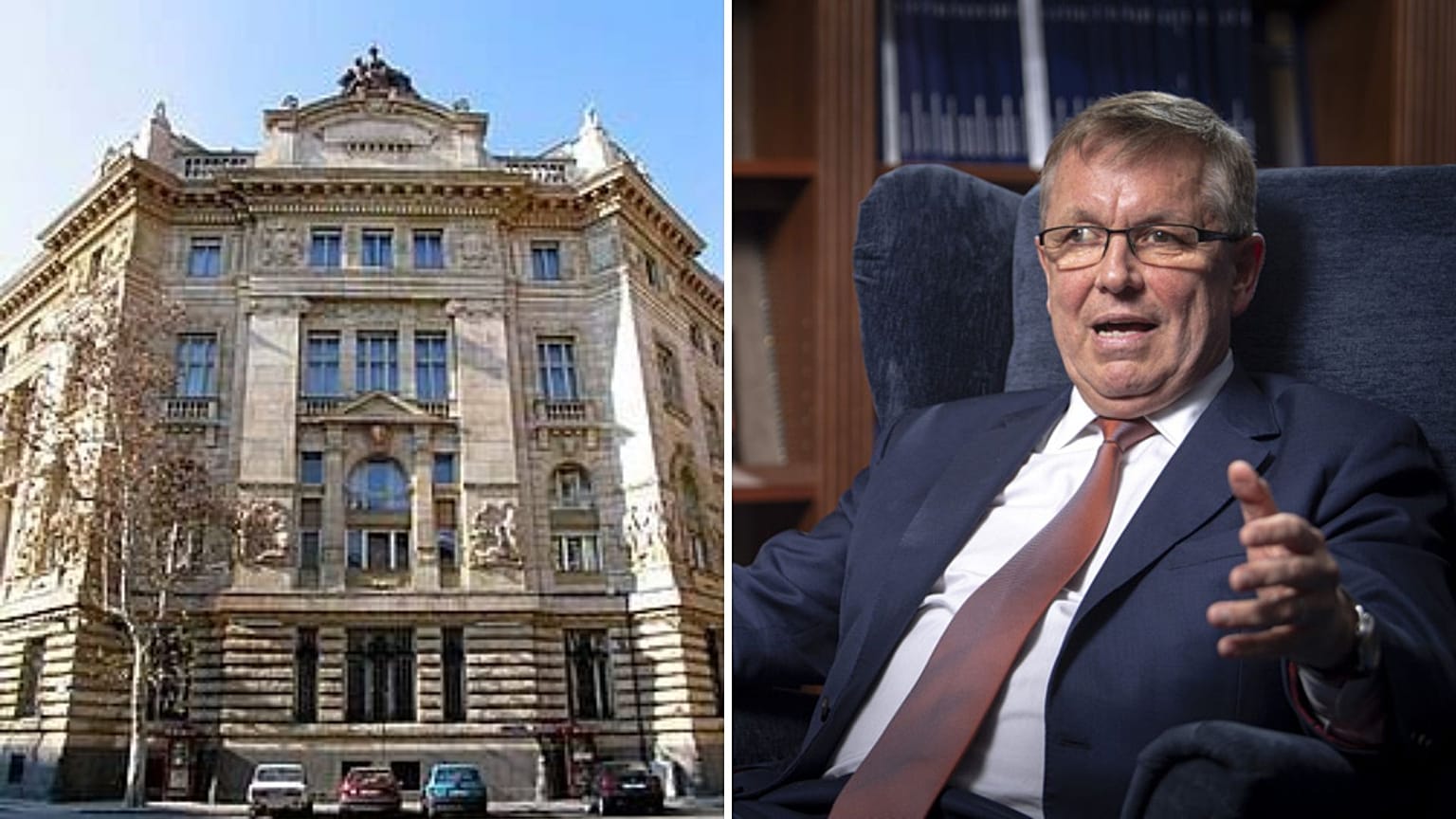














The investigation follows scrutiny of the central bank's foundations, which managed more than €1 billion in public funds. Matolcsy has denied wrongdoing.
In a dramatic escalation of Hungary’s ongoing political transition and anti-corruption crackdown, György Matolcsy, the powerful former Governor of the Hungarian National Bank (MNB), was taken into police custody early Wednesday morning. The coordinated, multi-location operation marks one of the most high-profile law enforcement actions in the country's modern history, targeting an economic architect who for over a decade stood at the absolute center of Hungary’s financial policy and power structure.
 ADVERTISEMENT
Matolcsy was taken to the Central Chief Prosecution Office for investigations. A longtime associate of former Prime Minister Viktor Orbán, Matolcsy led the National Bank of Hungary (MNB) for 12 years until 2025.
- Matolcsy's lawyer, Pál Bátki told Hungarian newspaper Telex.
The Central Investigative Chief Prosecutor's Office (KNYF) confirmed that it conducted sweeping raids at multiple properties across the country. The wider investigation, officially dubbed the "NBH case," is centered on suspected breach of trust and the mismanagement of public funds causing particularly severe financial damage. The dramatic morning raid was carried out with the assistance of the National Investigation Bureau (NNI), the Budapest Police, and the National Protective Service, with operational security provided by the Standby Police.
While a detention for questioning does not automatically equate to formal pre-trial custody, it signals that prosecutors believe they have amassed enough evidence to justify a restrictive holding pattern as they prepare formal charges. It remains unclear whether Matolcsy will be allowed to leave after questioning. If he is formally named as a suspect, a court may decide whether to order his pre-trial detention. Matolcsy was questioned as a suspect in a separate case in September over alleged abuse of office involving pressure on Erste Bank Hungary, part of Austria's Erste Group. He denied the allegations and was allowed to leave after questioning.
Prosecutors said they expected to release further details early in the evening, once the initial investigative steps had been completed.
The Billions in the Foundations: What Lies Behind the Case
To understand the gravity of Matolcsy’s arrest, one must look back at his turbulent 2013–2025 tenure as head of the central bank, a period deeply intertwined with the previous administration of Viktor Orbán. The primary catalyst for the current criminal investigation stems from a sprawling network of foundations established by the MNB starting in 2014, most notably the Pallas Athéné Domus Meriti Foundation (PADME).
Under Matolcsy's leadership, the central bank endowed these foundations with roughly 266 billion Hungarian forints (approximately €650 million) in public money. At the time, the central bank famously argued that these funds "lost their public character" once transferred to the foundations—a legal theory that sparked fierce public outrage and constitutional debates for years. The day-to-day management of this massive wealth was handed over to Optima Investment Ltd., a firm closely linked to central bank circles.
The turning point came in March 2025, just as Matolcsy’s final term at the MNB expired and he was succeeded by former Finance Minister Mihály Varga. A comprehensive audit by the State Audit Office (ÁSZ) exposed severe management failures, massive structural deficits, and a pattern of highly questionable real estate acquisitions. Investigators discovered that the foundations had routinely purchased luxury real estate and international stocks at heavily inflated prices, causing catastrophic losses to the bank’s ultimate balance sheet. The ÁSZ audit estimated the total financial damage and misreported asset values at up to 150 billion forints (around €365 million), prompting an immediate criminal complaint for embezzlement, negligence, and fraud.
Compounding Matolcsy’s legal woes is a secondary, separate criminal probe that escalated in September 2026. In that case, reported on Portfolio.hu, the National Investigation Bureau interrogated Matolcsy and six other individuals as suspects for abuse of office. This related to allegations that central bank officials had used regulatory and political leverage to pressure Erste Bank Hungary to remove András Simor—another former central bank governor—from his supervisory board role at Erste Group in Vienna. Matolcsy has vehemently denied wrongdoing in both matters, calling the allegations baseless.
A Changing Political Landscape
The arrest of György Matolcsy cannot be divorced from the tectonic shifts in Hungary’s political landscape. Prime Minister Péter Magyar, who assumed office following a historic electoral victory over Viktor Orbán in April 2026, has positioned the eradication of systemic corruption as the cornerstone of his administration's domestic policy.
Following through on campaign promises to hold former officials and oligarchical networks accountable, Magyar’s government launched the National Asset Recovery and Protection Office in July 2026. Dubbed a "superauthority" by political analysts, this specialized agency wields broad prosecutorial and investigative powers, allowing it to bypass bureaucratic gridlock by directly coordinating police, tax authorities, and prosecutors.
Commenting on the arrest via social media, Prime Minister Magyar stated that the crackdown marks the true beginning of public accountability, emphasizing that the days of consequence-free financial mismanagement are over. As parliamentary committees sift through over 30,000 pages of internal central bank documents turned over by the current MNB leadership, legal experts anticipate that Wednesday’s high-profile arrest may only be the first phase of a much wider judicial reckoning.